Editorial · Issue 5
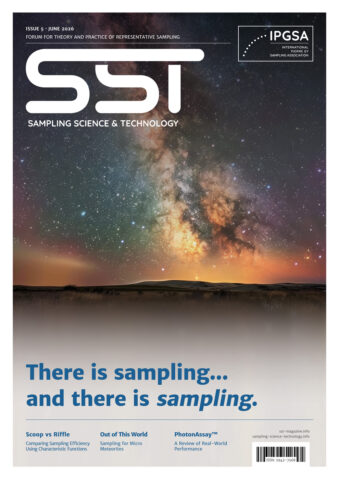
There is sampling … and there is sampling
As an erstwhile geology student, the editor first encountered a famous expression: “There are granites … and there are granites”, meaning that granites originate from more than one geologic process as it was thought at that time, more than 50 years ago. It has later transpired that this may not be so, after all - scientific progress!
Fast forward: There is sampling - in the ‘classic’ Theory of Sampling (TOS) context, i.e., physical sampling of heterogeneous particulate and aggregate materials, mixtures, processes, slurries including sampling by proxy, e.g., process sampling using sensor technology (‘Process Analytical Technology, PAT’), which accomplishes the same purpose ‘sampling for analysis’ without extracting physical samples from a process stream. The previous issue of SST#4 was fully dedicated to PAT.
… and then there is sampling, different from the above. What could this be? Here are few suggestions:
- Theoretically augmented sampling process comparison (– is TOS not enough?)
- Physically exotic sampling processes (developing new sampling avenues)
- Sampling of unusual or exotic materials, not normally considered traditional TOS targets (lots)
- Sampling under unusual conditions or using special sampling procedures and equipment
In this issue of SST, almost anything goes so long it is not (too) traditional, (too) main stream, or (too much) more-of-the-same …
The theme for this issue has been out on solicitation for a long time. This issue is crammed with examples and case histories of … sampling:
- Let’s take a broader view of the way TOS can be augmented (article 1)
- Be enchanted by the out-of-this-world story of how one man singularly developed, and popularised (in the best meaning of the word), the distinctly non-traditional sampling necessary for addressing a new scientific niche area: Micrometeorites (2)
- Let’s assess an evaluation of a new highly praised analytical approach – Photon Assay (3,4) vs. a rebuttal and comprehensive justification [...]
Read the editorial